Q1. The Fibonacci sequence is defined as
 for n > 2. Find an+1/an for n = 2 and 3.
for n > 2. Find an+1/an for n = 2 and 3. Solution
The Fibonacci sequence is defined as for n > 2.
The terms of this sequence are:

for n > 2.
The terms of this sequence are:
Q2. Let ‘a’ be the AM and b & c be two GM’s between two any positive numbers. Then prove that  .
.
.Solution
Let x and y be two positive numbers, then
a is AM of x and y  Also, x, b, c, y is the G.P. with common ratio of

Also, x, b, c, y is the G.P. with common ratio of
Q3. Find the
sum of the series 22 + 42 + 62 + 82
+ … to n terms.
Solution

Q4. 
Solution

Q5. The sum of n terms of two APs are in the ratio (7n + 1):(4n + 27). Find the ratio of their 13th term.
Solution

Q6. Find the least value of n for which 1 + 3 + 9 + 27 + … to n terms is greater than 7000. [Use log 140.01 = 2.1461 and log 3 = 0.4771]
Solution
Here, we have

 Thus, the least value of n is 9.
Thus, the least value of n is 9.
Q7. If the sum of n terms of three AP’s are S1, S2, S3. The first term of all the AP’s are unity and the common difference are 1, 2 and 3 respectively. Then prove that  .
.
. Solution
We have,

Q8. Between 1 and 31, n numbers have been inserted in such a way that the resulting sequence is an A. P. and the ratio of 7th and (n – 1)th numbers is 5 : 9. Find the value of n.
Solution
Let A1, A2, A3, …, An be n arithmetic means between 1 and 31 and common difference be d.
Total number of terms = n + 2
First term = 1, last term = (n + 2)th term = 31

 Thus, the number of inserted numbers is 14.
Thus, the number of inserted numbers is 14.
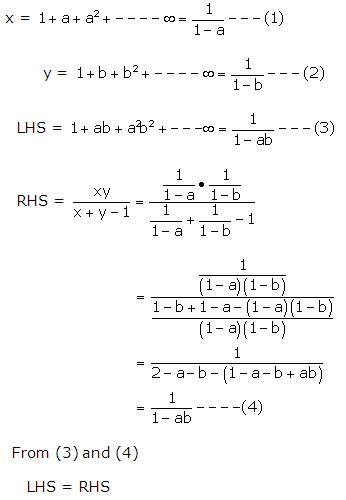
Q9. 
Solution
Q10. Find the first three terms of sequence, if sum of n terms is  .
.
.Solution
Let sum of n terms be .
Here,
.
Here, 
 Thus, first three terms of this sequence are 1, 2 and 3.
.
Here,
Thus, first three terms of this sequence are 1, 2 and 3.
Q11. Find the numbers whose arithmetic mean is 82 and geometric mean is 18.
Solution
Let numbers be a and b.
 Then the numbers are 162 & 2 or 2 & 162.
Then the numbers are 162 & 2 or 2 & 162.
Q12. Find the
sum of the series 1.22 + 2.32 + 3.42 + … to n terms.
Solution

Q13. Find the
sum of the series 2n2 - 3n + 5 to n terms.
Solution

Q14. Find the sum to n terms of the series
Solution
The given series is

Q15. If S be the sum, P the product and R the sum of the reciprocals of n terms of a G.P., then prove that  .
.
.Solution
Let first term and common ratio of this G.P. be ‘a’ and r respectively.


Q16. Sum the
following series to n terms:
3 + 18 +
57 + 132 + 255 + …
Solution


Q17. 
Solution

Q18. Find the sum of the series 1 + (1 + 2) + (1 + 2 + 3) + … up to n terms.
Solution
Here, Tn = (1 + 2 + 3+ … + n) =  Sum of n terms

Sum of n terms
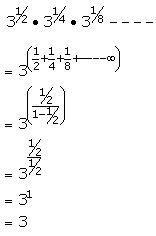
Q19. 
Solution
Q20. If x, y, z are in A.P. A1 is the mean of x & y and A2 is the mean of y & z. Then prove that the mean of A1 and A2 is y.
Solution
Here, x, y, z are in AP, then
 Now, A1 = mean of x and y
 Also, A2 = mean of y and z
 Now, we have to prove that the mean of A1 and A2 is y.
 Hence, proved.
Now, A1 = mean of x and y
Also, A2 = mean of y and z
Now, we have to prove that the mean of A1 and A2 is y.
Hence, proved.
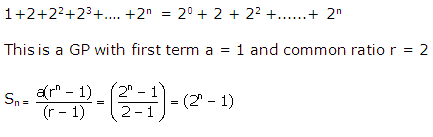
Q21. Find the sum of the series 1+2+22+23+--- +2n
Solution
Q22. 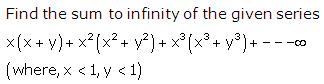
Solution
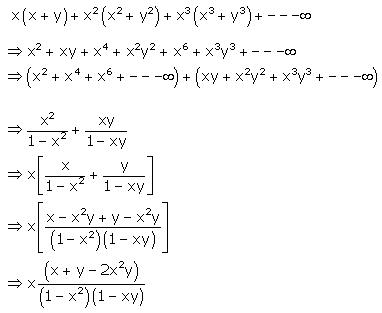
Q23. 
Solution

Q24. Write the
sum to n terms of the series

Solution

Q25. Find the sum of the following series up to 16 terms.
up to 16 terms.Solution
Let Tn be the nth term of the given series.
Here,

Q26. Insert 6 numbers between – 6 and 29 such that the resulting sequence is an A.P.
Solution
Let A1, A2, A3, …, A6 be 6 arithmetic means between – 6 and 29 and common difference be d.
Total number of terms = 6 + 2 = 8
 Thus, the A.P. is – 6, – 1, 4, 9, 14, 19, 24, 29.
Thus, the A.P. is – 6, – 1, 4, 9, 14, 19, 24, 29.
Q27. Find two positive numbers whose difference is 12 and whose AM exceeds GM by 2.
Solution
Let a and b be two numbers, such that a – b = 12 …(1) and
AM – GM = 12
 Thus, the numbers are 16 and 4.
Thus, the numbers are 16 and 4.
Q28. If the 4th and 9th terms of a G.P. are 18 and 4374. Find the G.P.
Solution
Let first term and common ratio of this G.P. be ‘a’ and r respectively.
 Dividing equation (2) by (1), we get
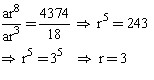 On putting r = 3 in equation (1), we get
 Thus, the required G.P. is
Dividing equation (2) by (1), we get
On putting r = 3 in equation (1), we get
Thus, the required G.P. is
Q29. Sum the
following series to n terms:
2 + 10 +
30 + 68 + 130 + …
Solution

Q30. Find the number of arithmetic means between 7 and 71 in such a way that 5th mean is 27.
Solution
Let A1, A2, A3, …, An be n arithmetic means between 7 and 71 and common difference be d.
Total number of terms = n + 2
First term = 7, last term = (n + 2)th term = 71
 Thus, there are 15 AM's inserted between 7 and 71.
Thus, there are 15 AM's inserted between 7 and 71.
Q31. The A. M. between two positive numbers a and b is twice the G. M. between them. Find the ratio of the numbers.
Solution
Here, given that AM of a and b = 2(GM of a and b)

Q32. If the fourth term of a G.P. is 3. Find the product of first 7 terms.
Solution
Let first term and common ratio of this G.P. be ‘a’ and r respectively.
Fourth term =  …(1)
Product of first seven terms =
…(1)
Product of first seven terms = 
 Thus, the product of first seven terms of this G.P. is 2187.
…(1)
Product of first seven terms =
Thus, the product of first seven terms of this G.P. is 2187.
Q33. Find the first five terms of the sequence
 .
.
.Solution
Here,
For n = 1, 2, 3, 4, and 5, we can get the first five terms of this sequence.
 Thus, the first five terms of the given sequence are 1, 5, 14, 30 and 55.
For n = 1, 2, 3, 4, and 5, we can get the first five terms of this sequence.
Thus, the first five terms of the given sequence are 1, 5, 14, 30 and 55.
Q34. 
Solution

Q35. Find the 19th term of the sequence
 .
.
.Solution
Here, the sequence <an> is defines as
 The 19th term of the given sequence is 1/3.
The 19th term of the given sequence is 1/3.
Q36. Find n such that  may be the G.M. between positive numbers a and b.
may be the G.M. between positive numbers a and b.Solution
The G.M. between a and b is .
.


.
Q37. How many terms are there in the AP.  .
.
.Solution
Let there be n terms in this A.P.
Here, first term a1 = 20, common difference  and nth term an = – 10
 There are 41 terms in the A.P.
and nth term an = – 10
There are 41 terms in the A.P.
Q38. Find the sum of 50 terms of the sequence 9, 9.9, 99.9, 999.9 …
Solution
The given sequence is 9, 9.9, 99.9, 999.9 …….
Sum = 9 + 9.9 + 99.9 + 999.9+ ……50 terms
= [10 –1] + [10 – 0.1] + [10 – 0.01] +…….50 terms
= [10 +10 +10…..50 terms] – [1+0.1+0.01+0.001+….50 terms.]
= 500 – (sum of G.P. of 50 terms with a= 1, r = 0.1)
 =
= 
=
Q39. Let <an> be a sequence defined by
 . Find

. Find
Solution
Here,

Comments
Post a Comment