Q1. How many liters of water will have to be added to 1125 liters of the 45% solution of acid so that the resulting mixture will contain more than 25% but less than 30% acid content?
Solution
Let us assume that l liters of water is added to 1125 liters so that the resulting mixture contain more than 25% but less than 30% acid solution.
Lets first calculate the acid content in 1125 liters (45% acid).
i.e.,  liters
Now when l liter of solution is added so the volume becomes (1125 + l) liter. Now according to question the acid content should be more than 25% but less than 30% so
liters
Now when l liter of solution is added so the volume becomes (1125 + l) liter. Now according to question the acid content should be more than 25% but less than 30% so
 Now this can be written as two inequalities,
 and
and  Multiplying by 100


 Solving 2nd inequality

 then
then  Hence the quantity of water added should be greater than 562.5 litre but less than 900.
liters
Now when l liter of solution is added so the volume becomes (1125 + l) liter. Now according to question the acid content should be more than 25% but less than 30% so
Now this can be written as two inequalities,
and
Multiplying by 100
Solving 2nd inequality
then
Hence the quantity of water added should be greater than 562.5 litre but less than 900.
Q2. Find the integral values of two numbers such that their sum is 11 and the product is greater than 28.
Solution
Let the numbers be x & y

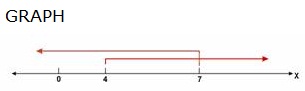 4< x < 7
Integral values of x=5,6
Hence corresponding value of y= 6,5
So the solution is x=5, y=6 or x=6, y=5
4< x < 7
Integral values of x=5,6
Hence corresponding value of y= 6,5
So the solution is x=5, y=6 or x=6, y=5
4< x < 7
Integral values of x=5,6
Hence corresponding value of y= 6,5
So the solution is x=5, y=6 or x=6, y=5
Q3. Find the solution for the pair of inequalities x +5 >2x-9 and 2x-11>4(x-1).
Solution
x +5 > 2x-9, 2x-11 > 4(x-1)
-x > -14, 2x-11 > 4x - 4
x < 14, -2x > 7
x <  -3.5 > x
 Clearly, from the graph the solution is x < -3.5
-3.5 > x
Clearly, from the graph the solution is x < -3.5
Q4. In a game, a person wins if he gets the sum greater than 20 in four throws of a die. In three throws he got numbers 6, 5, 4. What should be his fourth throw, so that he wins the game?
Solution
Numbers obtained in three throws are 6, 5 and 4. Let the number obtained in fourth throw be x. Now, Sum > 20
 6 + 5 + 4 + x > 20
15 + x > 20
x > 20 – 15
x > 5
6 + 5 + 4 + x > 20
15 + x > 20
x > 20 – 15
x > 5
 He must get a 6 in the fourth throw to win the game.
6 + 5 + 4 + x > 20
15 + x > 20
x > 20 – 15
x > 5
He must get a 6 in the fourth throw to win the game.
Q5. Find all pairs of consecutive odd positive integers, both of which are greater than 15, such that their sum is less than 50.
Solution
Let the pair of consecutive odd positive integers be x, x + 2 such that both are greater than 15 and their sum is less than 50
 x > 15 and x + (x + 2) < 50
x > 15 and 2x + 2 < 50
x > 15 and 2x < 48
x > 15 and x < 24
15 < x < 24 and x is odd
x = 17, 19, 21, 23 and therefore, x + 2 = 19, 21, 23, 25
x > 15 and x + (x + 2) < 50
x > 15 and 2x + 2 < 50
x > 15 and 2x < 48
x > 15 and x < 24
15 < x < 24 and x is odd
x = 17, 19, 21, 23 and therefore, x + 2 = 19, 21, 23, 25
 Possible pairs are (17, 19), (19, 21), (21, 23), (23, 25)
x > 15 and x + (x + 2) < 50
x > 15 and 2x + 2 < 50
x > 15 and 2x < 48
x > 15 and x < 24
15 < x < 24 and x is odd
x = 17, 19, 21, 23 and therefore, x + 2 = 19, 21, 23, 25
Possible pairs are (17, 19), (19, 21), (21, 23), (23, 25)
Q6. Solve the inequality and represent the solution graphically on the number line.

Solution
or  or
or 

Q7. Show that the solution set is empty for the system of inequations: 2x- 1, 4x-2y-9
 0
0
1, 4x-2y-90Solution
The graphs for the lines 2x - y = 1 and 4x -2 y =9 are
 The region shaded in green represents the inequality 2x - y
  1 and the orange shaded region represents 4x -2y
  9. Clearly there is no common portion of both the regions. Hence the solution set of the given system is empty.
The region shaded in green represents the inequality 2x - y 1 and the orange shaded region represents 4x -2y 9. Clearly there is no common portion of both the regions. Hence the solution set of the given system is empty.
Q8. A company manufactures cassettes and its cost equation for a week is C = 300 + 1.5x and its revenue equation is R = 2x, where x is the number of cassettes sold in a week. How many cassettes must be sold for the company to realize a profit?
Solution
For profit: Revenue > Cost
 2x > 300 + 1.5x
2x – 1.5x > 300
(0.5)x > 300
2x > 300 + 1.5x
2x – 1.5x > 300
(0.5)x > 300
 x > 600
 Number of cassettes sold > 600
2x > 300 + 1.5x
2x – 1.5x > 300
(0.5)x > 300
x > 600
Number of cassettes sold > 600
Q9. Show that the solution set is empty for the system of inequalities
2x + y &gege; 4 and 2x + y < -6
Solution
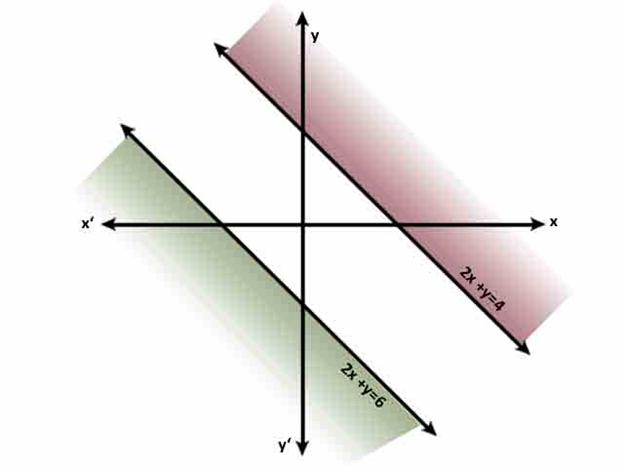
We draw the graphs for the lines 2x + y = 4 and 2x + y = -6
Now you can see that the region shaded in red represents the inequality
2x + y ≥ 4 and that in green represents 2x + y < -6 clearly there is no portion of both the regions in common and hence the solution set of given system is empty.
Q10. Find the area enclosed by the system of inequalities

Solution
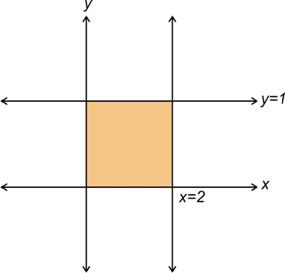
The required region will be given by the rectangle ABCD and hence the area enclosed is 2 sq. units
Q11. Find the vertices of the figure enclosing the region represented by the following system of inequalities.
7x + 10y  70 3x + y 18 x 0, y 1.
70 3x + y 18 x 0, y 1.Solution
We first draw the graphs of the linear equations 7x + 10y = 70,
3x + y = 18 and y = 1.
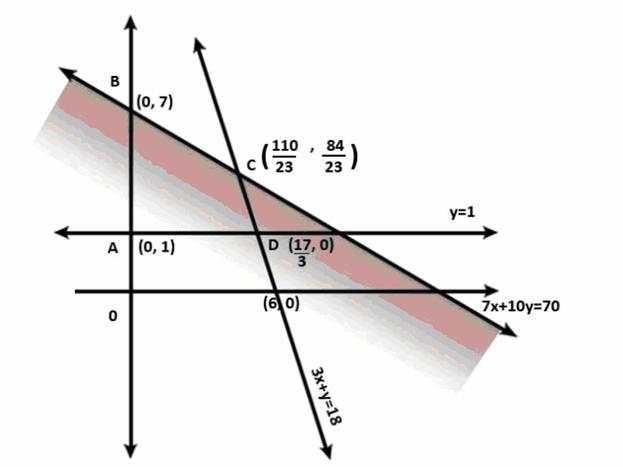 The region which represents the inequality 7x + 10y
 70 is containing the origin.
The region which represents the inequality 3x + y 18 is also containing the origin.
The region which represents the inequality y
70 is containing the origin.
The region which represents the inequality 3x + y 18 is also containing the origin.
The region which represents the inequality y  1 is the region away from origin i.e on the right side of line y = 1 and of course x 0 is the region on the right side of y axis.
Hence the common region is given by ABCD and the vertices are A (0, 1), B(0, 7) C
1 is the region away from origin i.e on the right side of line y = 1 and of course x 0 is the region on the right side of y axis.
Hence the common region is given by ABCD and the vertices are A (0, 1), B(0, 7) C , D
, D 
The region which represents the inequality 7x + 10y 70 is containing the origin.
The region which represents the inequality 3x + y 18 is also containing the origin.
The region which represents the inequality y 1 is the region away from origin i.e on the right side of line y = 1 and of course x 0 is the region on the right side of y axis.
Hence the common region is given by ABCD and the vertices are A (0, 1), B(0, 7) C, D
Q12. IQ of a person is given by the formula  , where M A is mental age and CA is chronological age. If
  for a group of 15-year children, find the range of their mental age.
, where M A is mental age and CA is chronological age. If for a group of 15-year children, find the range of their mental age.Solution
Given,





 Range of mental age is 15 to 24
Range of mental age is 15 to 24
Q13. The water acidity in a pool is considered normal when the average pH reading of three daily measurements is between 9.2 and 9.8. If first two pH readings are 9.48 and 9.85, find the range of pH value for the third reading that will result in the acidity level being normal.
Solution
Let the third reading be x


 27.6 < 19.33 + x < 29.4
27.6 – 19.33 < x < 29.4 - 19.33
8.27 < x < 10.07
Range of pH value for third reading is 8.27 to 10.07
27.6 < 19.33 + x < 29.4
27.6 – 19.33 < x < 29.4 - 19.33
8.27 < x < 10.07
Range of pH value for third reading is 8.27 to 10.07
27.6 < 19.33 + x < 29.4
27.6 – 19.33 < x < 29.4 - 19.33
8.27 < x < 10.07
Range of pH value for third reading is 8.27 to 10.07
Comments
Post a Comment