Q1. If P(n) be the statement `12n + 3’ is a multiple of 5, then show that P(3) is false, whereas P(6) is true.
Solution
P(n): `12n + 3’ is a multiple of 5.
 P(3) is the statement `12 x 3 + 3’ is a multiple of 5, which is false.
And P(6) is the statement `12 x 6 + 3’ is a multiple of 5, which is true.
P(3) is the statement `12 x 3 + 3’ is a multiple of 5, which is false.
And P(6) is the statement `12 x 6 + 3’ is a multiple of 5, which is true.
P(3) is the statement `12 x 3 + 3’ is a multiple of 5, which is false.
And P(6) is the statement `12 x 6 + 3’ is a multiple of 5, which is true.
Q2. Prove by using the principle of mathematical induction thatx2n - y2n is divisible by (x + y).
Solution
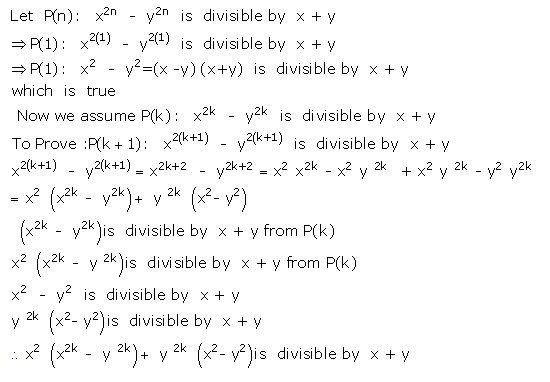
Q3. 
Solution


Q4. Let P(n) be the statement n3 + (n + 1)3 + (n + 2)3 is divisible by 9 for all n  N. If P(k) is true, then show that P(k + 1) is true.
N. If P(k) is true, then show that P(k + 1) is true.Solution

Q5. If P(n) be the statement ‘n2 – n + 41 is a prime number’, then show that P(1), P(2) are true but P(41) is not true.
Solution
P(n): n2 – n + 41 is a prime number.
P(1): 12 – 1 + 41 is a prime number i.e. P(1) = 41 is prime, which is true.
P(2): 22 – 2 + 41 is a prime number i.e. P(2) = 43 is prime, which is true.
P(41): 412 – 41 + 41 is a prime number i.e. P(41) = 412 is prime, which is not true.
Q6. Show by using principle of mathematical induction, prove that:
1 + 2 + 3 + -----+ n = 
Solution
Let the given statement is P(n)
P(n) = 1 + 2 + 3 + --- + n =
For n = 1, P(1) = is true, since 1 =  Assume that P(k) is true for some positive integer k, i.e.
1 + 2 + 3 + ---+ k =
Assume that P(k) is true for some positive integer k, i.e.
1 + 2 + 3 + ---+ k =  We shall prove that P(k +1) is true, whenever P(k) is true.
We have, 1 + 2 + 3 + -----+ k + (k + 1) = + (k + 1)
We shall prove that P(k +1) is true, whenever P(k) is true.
We have, 1 + 2 + 3 + -----+ k + (k + 1) = + (k + 1)
 Thus P(k +1) is true, whenever P(k) is true.
Hence from principle of mathematical induction, the statement P(n) is true for all natural numbers N.
Thus P(k +1) is true, whenever P(k) is true.
Hence from principle of mathematical induction, the statement P(n) is true for all natural numbers N.
For n = 1, P(1) = is true, since 1 =
Assume that P(k) is true for some positive integer k, i.e.
1 + 2 + 3 + ---+ k =
We shall prove that P(k +1) is true, whenever P(k) is true.
We have, 1 + 2 + 3 + -----+ k + (k + 1) = + (k + 1)
Thus P(k +1) is true, whenever P(k) is true.
Hence from principle of mathematical induction, the statement P(n) is true for all natural numbers N.
Q7. Prove that 102n – 1 + 1 is divisible by 11 for all n  N.
N.
N.Solution
Let P(n): 102n – 1 + 1 is divisible by 11
P(1): 10 + 1 = 11which is divisible by 11.
Thus P(n) is true for n = 1.
Let P(k) be true for some natural number k.
i.e. 102k – 1 + 1 is divisible by 11.
Let 102k – 1 + 1 = 11d
Now we prove that P(k + 1) is true whenever P(k) is true.
Now, P(k+1): 102k+1 + 1 = (11d – 1)100 + 1 = 11 (100d – 9),which is divisible by 11.
 P(k + 1) is true.
Thus P(k +1) is true whenever P(k) is true.
P(k + 1) is true.
Thus P(k +1) is true whenever P(k) is true.
 By principle mathematical induction 102n – 1 + 1 is divisible by 11 for all n N.
P(k + 1) is true.
Thus P(k +1) is true whenever P(k) is true.
By principle mathematical induction 102n – 1 + 1 is divisible by 11 for all n N.
Q8. Let P(n) be the statement  . What are P(3) and P(n + 1)?
. What are P(3) and P(n + 1)?Solution
 P(3): 33 > 3
i.e. P(3): 27 > 3
P(n + 1): 3n + 1 > n + 1
P(3): 33 > 3
i.e. P(3): 27 > 3
P(n + 1): 3n + 1 > n + 1
Q9. 
Solution

Q10. Let P(n) be the statement  , If P (k) is true , then show that P(k + 1) is true.
, If P (k) is true , then show that P(k + 1) is true.Solution
We are given that P (k) is true.
We shall prove that P (k +1) is true, whenever P (k) is true.
P (k): k < 2k
 Thus P(k + 1) is true, whenever P(k) is true.
Thus P(k + 1) is true, whenever P(k) is true.
Comments
Post a Comment