Q1. 
Solution

Q2. 
Solution

Q3. Let A = {2, 4, 6, 8, 10} and B = {(a, b) : a divides b; a , b  A}. Write the elements of B.
A}. Write the elements of B.Solution
B = {(2, 2), (2, 4), (2, 6), (2, 8), (2, 10), (4, 8)}
Q4. If the set A has 4 elements and the set B = {4, 5, 6}, then find the number of elements in (A  B).
B).
B).Solution
Since, n(A) = 4 and n(B) = 3
Therefore n((A B) = 12
B) = 12
Q5. If A = {1, 2, 3}, B = {4}, C = {5}, verify that A  (B
(B  C) = (A B) (A C)
(B C) = (A B) (A C)Solution
(B C) = {4, 5}
So, A (B C) = {(1, 4), (1, 5), (2, 4), (2, 5), (3, 4), (3, 5)}
Now (A B) = {(1, 4), (2, 4), (3, 4)}
And (A C) = {(1, 5), (2, 5), (3, 5)}
Therefore, (A B) (A C) = {(1, 4), (1, 5), (2, 4), (2, 5), (3, 4), (3, 5)}
Hence, A (B C) = (A B) (A C)
C) = {4, 5}
So, A (B C) = {(1, 4), (1, 5), (2, 4), (2, 5), (3, 4), (3, 5)}
Now (A B) = {(1, 4), (2, 4), (3, 4)}
And (A C) = {(1, 5), (2, 5), (3, 5)}
Therefore, (A B) (A C) = {(1, 4), (1, 5), (2, 4), (2, 5), (3, 4), (3, 5)}
Hence, A (B C) = (A B) (A C)
Q6. The function f is defined by
 Draw the graph of f(x).
Draw the graph of f(x).Solution
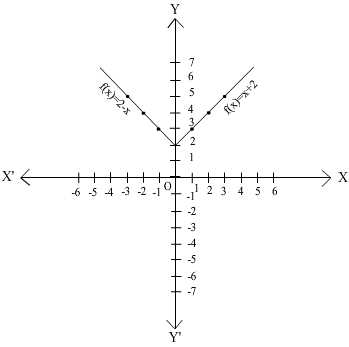
Here, f(x) = 2 – x, x < 0, this gives
f(-3) = 5, f(-2) = 4, f(-1) = 3,…
f(3) = 5, f(2) = 4, f(1) = 3,…
for f(x) = x + 2, x > 0.
Thus the graph of f is as follows-
Q7. If R is the relation ‘is less than’ from A = {2, 4, 6, 8, 10} and B = {2, 6, 10}, write down the Cartesian product corresponding to R.
Solution
Clearly R = {(a, b)  A
A  B; a < b}
 R = {(2, 6), (2, 10), (4, 6), (4, 10), (6, 10), (8, 10)}
A B; a < b}
R = {(2, 6), (2, 10), (4, 6), (4, 10), (6, 10), (8, 10)}
Q8. Let X = {2, 4, 6}, Y = {3, 5}and Z= {2, 3}, then find X  (Y
(Y  Z).
Z).
(Y Z).Solution
(Y Z) = {2, 3, 5}
Therefore,
X (Y Z) = {(2, 2), (2, 3), (2, 5), (4, 2), (4, 3), (4, 5), (6, 2), (6, 3), (6, 5)}
Z) = {2, 3, 5}
Therefore,
X (Y Z) = {(2, 2), (2, 3), (2, 5), (4, 2), (4, 3), (4, 5), (6, 2), (6, 3), (6, 5)}
Q9. 
Solution

Q10. Let R = {(3,1),(3, 5), (5, 1), (5, 5)} is a relation from A = {2,3,4,5} to B = {1,3, 5} Find the Codomain of R.
Solution
Codomain of R = {1, 3, 5}
Q11. 
Solution

Q12. If A = {x, y}, then find A  A A.
A A.
A A.Solution
A A A = {(x, x, x ), (x, x, y), (x, y, x), (x, y, y), (y, x, x), (y, x, y), (y, y, x) (y, y, y)}
A A = {(x, x, x ), (x, x, y), (x, y, x), (x, y, y), (y, x, x), (y, x, y), (y, y, x) (y, y, y)}
Q13. 
Solution

Q14. Let f: R  R be defined as
  Show that f is not a function.
R be defined as Show that f is not a function.Solution

Q15. 
Solution

Q16. Determine the domain and range of the relation R defined by
R = {(x + 2, x + 4): x  {0, 1, 2, 3, 4}
{0, 1, 2, 3, 4}Solution
Domain = {2, 3, 4, 5, 6}, Range = {4, 5, 6, 7, 8}
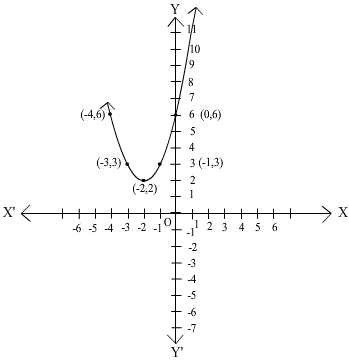
Q17. Draw the graph of the function y = x2 + 4x + 6.
Solution
The given function is
y = x2 + 4x + 6
= (x + 2)2 + 2
The graph of the given function will be a parabola.
The parabola will open upward.
The least value of (x + 2)2 is zero and will be so when x = -2.
When x = -2, y = 2
The vertex is (-2, 2).
So, the graph of the given function is as follows.
Q18. Determine the domain and range of the following relation on R: 
Solution
Domain of R = {1, 2, 3, 3, 5, 6, 7}

Q19. Let A = {2, 4, 6} and B = {6, 8, 12, 18}. Define a relation R from A to B by R= {(x, y): x divides y; x  A, y B}. Express R as a set of ordered pairs.
A, y B}. Express R as a set of ordered pairs.Solution
R = {(2, 6), (2, 8), (2, 12), (2, 18), (4, 8), (4, 12), (6, 6), (6, 12), (6, 18)}
Q20. Find the domain of the function given by:
 .
.
.Solution
f(x) is defined only when  or when x
  -1, -2
So, Domain of f(x) = R – {-1, -2}
-1, -2
So, Domain of f(x) = R – {-1, -2}
or when x -1, -2
So, Domain of f(x) = R – {-1, -2}
Q21. Let A = {1, 2, 3}, B = {1, 2, 3, 4, 5, 6, 7, 8, 9, 10} f: A  B be defined as f(x) = x + 5. Find the domain and range of the function.
B be defined as f(x) = x + 5. Find the domain and range of the function.Solution
We have,
f(x) = x + 5
f(1) = 6, f(2) = 7, f(3) = 8
So, f = {(1, 6), (2, 7), (3, 8)}
Domain of f = {1, 2, 3}
Range of f = {6, 7, 8}
Comments
Post a Comment