Q1. 
Solution

Q2. By giving a counter example, show that the following statement is falseP:If two triangles are equiangular then they are congruent.
Solution
The given statement is false since, all equilateral triangles are equiangular but not all are congruent.
Q3. 
Solution
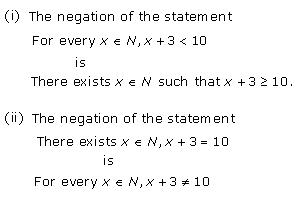
Q4. 
Solution
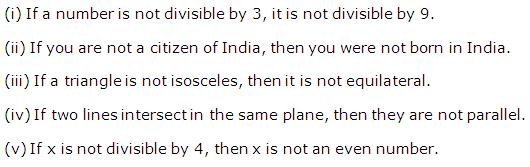
Q5. 
Solution
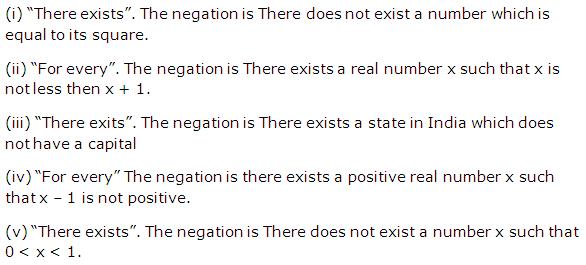
Q6. 
Solution

Q7. Write the connective used in the statementP: All whole numbers are either prime or composite.
Solution
The word 'Or' connects the two statements p: All whole numbers are prime, q: All whole numbers are composite, so the connective is 'Or'.
Q8.  *[in (iv) instead of x?y it will be x>y]
*[in (iv) instead of x?y it will be x>y]Solution
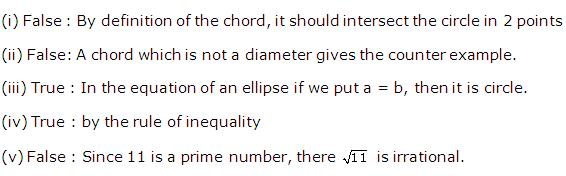
Q9. 
Solution
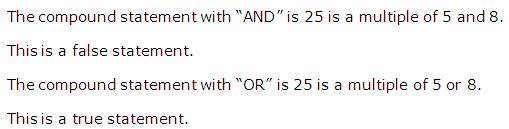
Q10. Write the negation of the given statement, p: Intersection of two disjoint sets is not an empty set.
Solution
P: Intersection of two disjoint sets is not an empty set
~P: Intersection of two disjoint sets is an empty set
Q11. 
Solution
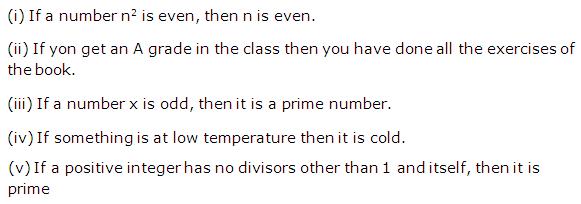
Q12. 
Solution
Since A and B are disjoint sets, so the intersection of two sets is empty set. Hence Truth value of statement is true
Q13. Find the truth value of p : "Every real number is either prime or composite."
Solution
Giving one counter example is enough to prove the false hood of a statement. Here counter example is: The real number 1 is neither prime nor composite. So the statement is false.
Comments
Post a Comment