Q1. 
Solution

Q2. 
Solution
Let the given points be D(p, 0), E(r, s) and F(0, q)
Since the points lie on the same line,
Slope of DE = Slope of EF
Slope of DE =  Slope of EF =
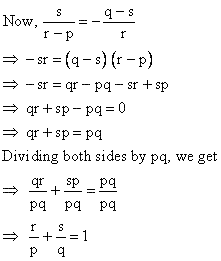
Slope of EF =
Q3. Without using distance formula, show that the points (-2, 1), (5, 3), (6, 7) and (- 4, 5) are not the vertices of a parallelogram.
Solution

Q4. Find the slope of line which passes through the point (5, 6) and the mid-point of line joining the points (4, 6) and (-3, 7).
Solution
Mid-point joining the line segment the points (4, 6) and (-3, 7) =  Slope of line joining the points (5, 6) and
Slope of line joining the points (5, 6) and
Q5. If three points (3, 6), (-5, 7) and (x, 1) are collinear, find the value of x.
Solution
If three points are collinear, then 

Q6. If the slope of line joining the points (2, 3) and (4, -5) is equal to the slope of line joining the points (x, 5) and (5, 6). Find the value of x.
Solution
Slope of line joining points A (2, 3) and B (4, -5) =  Slope of line joining points P (x, 5) and Q (5, 6) =
  Since Slope of line joining points A (2, 3) and B (4, -5) = Slope of line joining points A (2, 3) and B (4, -5)

Slope of line joining points P (x, 5) and Q (5, 6) =
Since Slope of line joining points A (2, 3) and B (4, -5) = Slope of line joining points A (2, 3) and B (4, -5)
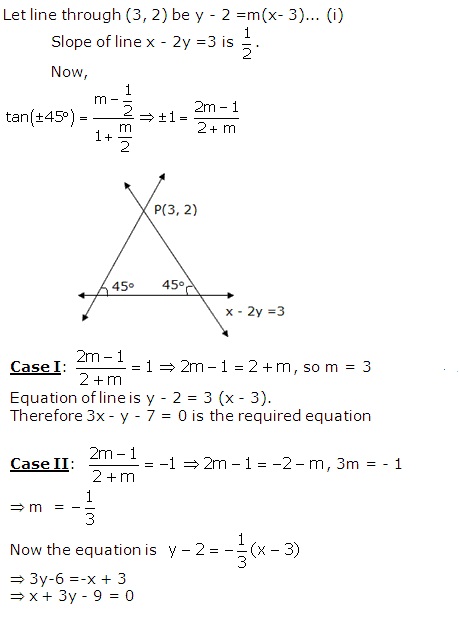
Q7. Find the equations of the lines through the point (3, 2) which are at an angle of 45o with the line x -2y = 3.
Solution
Q8. 
Solution


Q9. Find the coordinates of the foot of the perpendicular from the point (3, -4) to the line 4x - 15y + 17 = 0.
Solution
The equation of the given line is 4x - 15y + 17 = 0 ... (i)
The equation of a line perpendicular to the given line is 15x + 4y - k = 0, where k is a constant.
If this line passes through the point (3, -4), then
15 x 3 + 4 x (-4) - k = 0
 45 - 16 - k = 0
k = 29
Therefore the equation of a line passing through the point (3, -4) and perpendicular to the given line is
15x + 4y - 29 = 0 ... (ii)
The required foot of the perpendicular is the point of intersection of lines (i) and (ii).
Solving equation (i) and (ii), we get
45 - 16 - k = 0
k = 29
Therefore the equation of a line passing through the point (3, -4) and perpendicular to the given line is
15x + 4y - 29 = 0 ... (ii)
The required foot of the perpendicular is the point of intersection of lines (i) and (ii).
Solving equation (i) and (ii), we get
 Therefore, the foot of the perpendicular is given by

45 - 16 - k = 0
k = 29
Therefore the equation of a line passing through the point (3, -4) and perpendicular to the given line is
15x + 4y - 29 = 0 ... (ii)
The required foot of the perpendicular is the point of intersection of lines (i) and (ii).
Solving equation (i) and (ii), we get
Therefore, the foot of the perpendicular is given by
Q10. Find the coordinates of point C, which divides the line segment joining the points D (-2, 5) and E (4, 6) in the ratio 2 : 3.
Solution
Let the coordinates of point C is (x, y).
Co-ordinates of C = 
Q11. If p and q are the lengths of perpendicular from the origin to the lines x cos q - y sin q = k cos 2 q and x sec q + y cosec q = k respectively. Prove that p2 + 4q2 = k2.
Solution
The perpendicular distance from the origin to the line
x cos q - y sin q = k cos 2 q ... (i)
 Now,
x sec q + y cosec q = k
Now,
x sec q + y cosec q = k
 The perpendicular distance q from the origin to the line (ii)

Now,
x sec q + y cosec q = k
The perpendicular distance q from the origin to the line (ii)
Q12. Show that the line joining the points A(2, -3) and B(-5, 1) is parallel to the line joining the points C(7, -1) and D(0, 3) and perpendicular to the line joining the points P(4, 5) and Q(0, -2).
Solution

Q13. Find the angle between the line joining the points P (2, 1) and Q (3, -4) and the line joining the points A (-5, 3) and B (6, 7).
Solution
Slope of line joining the points P (2, 1) and Q (3, -4) = m1 =  Slope of line joining the points A (-5, 3) and B (6, 7) = m2 =
  Angle between two lines PQ and AB is:

Slope of line joining the points A (-5, 3) and B (6, 7) = m2 =
Angle between two lines PQ and AB is:
Q14. The slope of a line which makes an angle of 60o with the positive direction of y–axis is
- 1) 1
- 2) - 1
-
3)

-
4)

Solution
The angle made by a line with the positive direction of y-axis is complementary angle of the angle made by it with the positive direction of the x-axis.
Thus, the angle made with positive direction of x axis is 30o.

Q15. The slope of a line segment joining the points G (2a + 3, 4 – 5a) and the point which divides the line segment joining the points E (5, 3) and F (8, 5) in the ratio 3:4 is ½. Find the value of a.
Solution
Let the point D be the point which divides the line segment joining the points (5, 3) and (8, 5) in the ratio 3:4.
Therefore the coordinates of point D =  Slope of the line joining the points D and G =
  But the slope of line joining the points D and G is ½.

 23 – 14a = 70a – 2
25 = 84a
a =
23 – 14a = 70a – 2
25 = 84a
a = 
Slope of the line joining the points D and G =
But the slope of line joining the points D and G is ½.
23 – 14a = 70a – 2
25 = 84a
a =
Q16. 
Solution


Q17. Find the equation of the lines which cut off intercepts on the axes whose sum and product are 2 and - 8 respectively.
Solution
Let a, b be the intercepts, the lines makes on the axes
Sum of intercepts = a + b = 2 ---(i)
Product of intercepts = ab = -8 --- (ii)
From (i) and (ii),
a (2 - a) = -8
 2a - a2 = -8
a2 - 2a - 8 = 0
a2 -(4 - 2) a - 8 = 0
(a - 4) (a + 2) = 0
a - 4 = 0 or a + 2 = 0
a = 4 or a = - 2
If a = 4, then
4 + b = 2
b = - 2
And if a = - 2, then
- 2 + b = 2
b = 4.
Hence, equations of lines are
2a - a2 = -8
a2 - 2a - 8 = 0
a2 -(4 - 2) a - 8 = 0
(a - 4) (a + 2) = 0
a - 4 = 0 or a + 2 = 0
a = 4 or a = - 2
If a = 4, then
4 + b = 2
b = - 2
And if a = - 2, then
- 2 + b = 2
b = 4.
Hence, equations of lines are
 x - 2y = 4 and - 2x + y = 4.
2a - a2 = -8
a2 - 2a - 8 = 0
a2 -(4 - 2) a - 8 = 0
(a - 4) (a + 2) = 0
a - 4 = 0 or a + 2 = 0
a = 4 or a = - 2
If a = 4, then
4 + b = 2
b = - 2
And if a = - 2, then
- 2 + b = 2
b = 4.
Hence, equations of lines are
x - 2y = 4 and - 2x + y = 4.
Q18. If the lines 3x - 5y + 3 = 0, 5x + 7y - k = 0 and 2x - 3y - 5 = 0 are concurrent, find the value of k.
Solution
Lines are said to be concurrent, if they pass through a common point, i.e., point of intersection of any two lines lies on the other line. Here given three lines are
3x - 5y + 3 = 0 --- (i)
5x + 7y - k = 0 ---(ii)
And 2x - 3y- 5 = 0 --- (iii)
Solving equation (i) and (iii), we get
x = 34 and y = 21.
Therefore, the point of intersection of two lines (i) and (iii) is (34, 21).
Since above three lines are concurrent, the point (34, 21) will satisfy equation (ii) so that
5 x 34 + 7 x 21- k = 0
 170 + 147 - k = 0
k = 317.
170 + 147 - k = 0
k = 317.
170 + 147 - k = 0
k = 317.
Q19. Find the distance between the parallel lines m (x + y) – n = 0 and mx + my + r = 0.
Solution


Q20. Find the new coordinates of the point (4, 7) if origin is shifted to the point (3, 2) by a translation of axes.
Solution
Let new origin (h, k) = (3, 2) and (x, y) = (4, 7) be the given point, therefore new coordinates (X, Y) of (4, 7) are given by
x = X + h and y = Y + k i.e. 4 = X + 3 and 7 = Y + 2
This gives, X = 1 and Y = 5. Thus new coordinates are (1, 5).
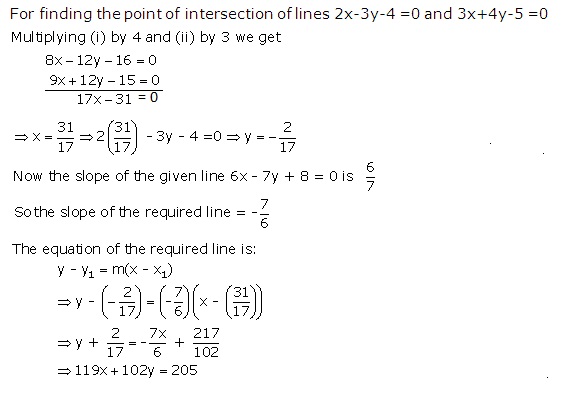
Q21. Find the equation of the line perpendicular to the line whose equation is 6x - 7y + 8 = 0 and that passes through the point of intersection of the two lines whose equations are 2x - 3y - 4 = 0 and 3x + 4y - 5 = 0.
Solution

Q22. Reduce the equation 4x + 3y – 9 = 0 to the normal form and find their length of perpendicular from origin to the line
Solution

Q23. In what ratio, the line joining (-2, 3) and (3, 5) is divided by the line 2x + y = 5.
Solution
The line joining the points (-2, 3) and (3, 5) is divided at P (x1, y1). Let this ratio be k:1.
 Point P is
  This point lies on the line 2x + y = 5.
 6k - 4 + 5k + 3 = 5k + 5
6k = 6
k = 1
P divides the line joining the points (-2, 3) and (3, 5) equally
6k - 4 + 5k + 3 = 5k + 5
6k = 6
k = 1
P divides the line joining the points (-2, 3) and (3, 5) equally
Point P is
This point lies on the line 2x + y = 5.
6k - 4 + 5k + 3 = 5k + 5
6k = 6
k = 1
P divides the line joining the points (-2, 3) and (3, 5) equally
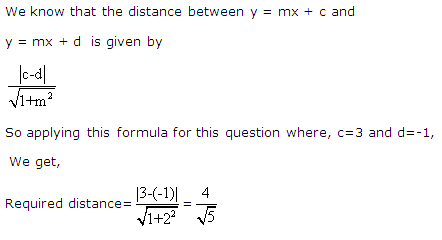
Q24. Find the distance between two parallel lines 2x - y + 3 = 0 And 2x - y - 1 = 0
Solution
Q25. 
Solution

Q26. Find the equation of the line passing through the point of intersection of the lines 5x - 2y + 7 = 0 and 3x - 4y - 5 = 0 that has equal intercepts on the axes.
Solution
Let the intercepts on the axes be a and b.
Since a = b
 The point of intersection of lines 5x - 2y + 7 = 0 and 3x - 4y - 5 = 0 is
  .
But the equation (i) passes through.
.
But the equation (i) passes through.

The point of intersection of lines 5x - 2y + 7 = 0 and 3x - 4y - 5 = 0 is .
But the equation (i) passes through.
Q27. What is the distance between the parallel lines 4(x + y) + 6 = 0 and 8x + 8y + 24 = 0
Solution

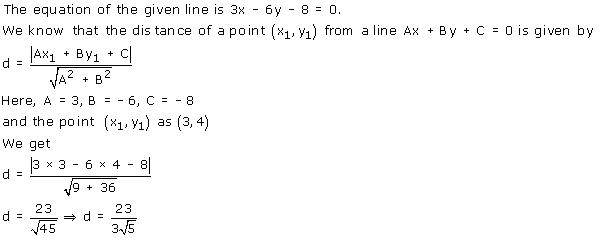
Q28. Find the distance of the point (3,4) from the line 3x - 6y - 8 = 0
Solution
Q29. Find the points on the y-axis, whose distances from the line  are 5 units.
are 5 units.Solution
The given line is
 8x + 6y = 48
Let any point on the y-axis be (0, y).
Perpendicular distance from (0, y) to the given line
8x + 6y = 48
Let any point on the y-axis be (0, y).
Perpendicular distance from (0, y) to the given line

 .
.
8x + 6y = 48
Let any point on the y-axis be (0, y).
Perpendicular distance from (0, y) to the given line
.
Q30. Find the angle between X-axis and the line joining the points (2, -4) and (-3, 5).
Solution
Slope of line joining the points A (2, -4) and B (-3, 5) = 

Comments
Post a Comment