Q1. Two finite sets have m and n elements. The total number of subsets of the first set is 112 more than the total number of subsets of the second set. Find the values of m and n.
Solution

Q2. If A = {1, 2, 3, 4, 5, 6, 7, 8, 9, 10}, write a subset B of A that contain all multiples of 3.
Solution
B = {3, 6, 9}
Q3. Are the sets A - B and B - A disjoint sets?
Solution

Q4. If A = {2, 4, 6, 8}, B = {1, 3, 5, 6}, C = {5, 6, 7, 8, 9}. Verify that (A  B) C = A (B C)
B) C = A (B C)Solution
A B = {1, 2, 3, 4, 5, 6, 8}
L.H.S. = (A B) C
= {1, 2, 3, 4, 5, 6, 8}{ 5, 6, 7, 8, 9}
= {1, 2, 3, 4, 5, 6, 7, 8, 9}
B C = {1, 3, 5, 6, 7, 8, 9}
R.H.S. = A (B C)
={ 2, 4, 6, 8}{1, 3, 5, 6, 7, 8, 9}
= {1, 2, 3, 4, 5, 6, 7, 8, 9}
Hence, L.H.S = R.H.S.
B = {1, 2, 3, 4, 5, 6, 8}
L.H.S. = (A B) C
= {1, 2, 3, 4, 5, 6, 8}{ 5, 6, 7, 8, 9}
= {1, 2, 3, 4, 5, 6, 7, 8, 9}
B C = {1, 3, 5, 6, 7, 8, 9}
R.H.S. = A (B C)
={ 2, 4, 6, 8}{1, 3, 5, 6, 7, 8, 9}
= {1, 2, 3, 4, 5, 6, 7, 8, 9}
Hence, L.H.S = R.H.S.
Q5. From the following Venn diagram determine A  B.
B.

B.
Solution
A B = {e, f}
B = {e, f}
Q6. If A = {2, 3, 4, 6}, B = {3, 5, 8}, C = {1, 3, 5, 8, 10}, then find (B – C) – (C – A):
Solution
B – C =  , C – A = {1, 5, 8, 10}
(B – C) – (C- A) =
, C – A = {1, 5, 8, 10}
(B – C) – (C- A) =
, C – A = {1, 5, 8, 10}
(B – C) – (C- A) =
Q7. Write the set {x : x  R, -4
R, -4  x 4} as intervals.
R, -4 x 4} as intervals.Solution
The set in which end points are included is written using square bracket.
So the given set in interval form can be written as [-4, 4]
Q8. Are the pair of sets A = {x : 3 < x < 4, x  Q} and B = { x : 3 < x < 4, x N} Disjoint?
Q} and B = { x : 3 < x < 4, x N} Disjoint?Solution
Here, A is the set of all rational numbers between 3 and 4. B is the set which does not contain any element.
Hence, A  B =
B =  . So, A and B are disjoint sets.
B = . So, A and B are disjoint sets.
Q9. Is the collection of all even numbers between 7 and 19 a set?
Solution
Given collection is a set as it is well-defined and it contains the elements 8, 10, 12, 14, 16 and 18.
Q10. Write the set of all integers ‘x’ such that  in roster form.
in roster form.Solution

Q11. List all the elements of the set A = {x : x is a natural numbers, 2x + 4 < 25}
Solution
2x + 4 < 25  2x < 21
x < 10.5
Hence, A = {1, 2, 3, 4, 5, 6, 7, 8, 9, 10}
2x < 21
x < 10.5
Hence, A = {1, 2, 3, 4, 5, 6, 7, 8, 9, 10}
2x < 21
x < 10.5
Hence, A = {1, 2, 3, 4, 5, 6, 7, 8, 9, 10}
Q12. How many elements has P(A), if A = {1}.
Solution

Q13. In a group, students know at least one of the languages, German or French. 100 students know German and 40 know French and 10 know both German and French. If there are 20 students who know neither of the two languages, how many students are there in the group?
Solution
Let G be the set of students who know German and F be the set of students who know French. So, we have
n(G  F) = n(G) + n(F) – n(G
  F)
F)
 n(G F) = 100 + 40 – 10 = 130
20 students who know neither of the two languages
So, total students = 130 + 20 = 150
n(G F) = 100 + 40 – 10 = 130
20 students who know neither of the two languages
So, total students = 130 + 20 = 150
F) = n(G) + n(F) – n(G F)
n(G F) = 100 + 40 – 10 = 130
20 students who know neither of the two languages
So, total students = 130 + 20 = 150
Q14. A survey was conducted on 110 people of Delhi. It was found that 65 people watched Hindi movie and 51 watched English movie and where as 24 watched both the movies. Find the number of people who did not watch any movie on that day.
Solution
Let A be the set of people who watched Hindi movie and B be the set of people who watched English movie.

 Thus the number of the people who watched either of the movie = 92
So, the number of people who did not watch any movie = 110 – 92 = 18.
Thus the number of the people who watched either of the movie = 92
So, the number of people who did not watch any movie = 110 – 92 = 18.
Thus the number of the people who watched either of the movie = 92
So, the number of people who did not watch any movie = 110 – 92 = 18.
Q15. From the following Venn diagram determine A  B.
B.

B.
Solution
A B = {1, 2, 3, 6, 8}
B = {1, 2, 3, 6, 8}
Q16. Out of 600 mobile owners investigated, 500 owned Nokia hand set and 180 owned Tata hand set; 30 owned both Nokia and Tata hand sets. Is this data correct?
Solution
Let U denote the universal set consisting of all mobile owners, N denote the set of all owners of Nokia hand set and T denote the set of all owners of Tata hand- set.
n(U) = 600, n(N) = 500, n(T) = 180, n(N  T) = 30.
So, we have
n (N
T) = 30.
So, we have
n (N  T) = n(N) + n(T) – n(N T)
= 500 + 180 – 30 = 650
Also, N T is a subset of U.
But n (N T)
T) = n(N) + n(T) – n(N T)
= 500 + 180 – 30 = 650
Also, N T is a subset of U.
But n (N T)  n(U)
n(U)
 650 600, which is impossible.
Given data is incorrect.
650 600, which is impossible.
Given data is incorrect.
T) = 30.
So, we have
n (N T) = n(N) + n(T) – n(N T)
= 500 + 180 – 30 = 650
Also, N T is a subset of U.
But n (N T) n(U)
650 600, which is impossible.
Given data is incorrect.
Q17. Is the following statement true? [3, 8]  (2, 10)
(2, 10)Solution
[3,8] = { x : 3  x 8, x
  R}
and (2, 10) = {x : 2 < x < 10, x
R}
and (2, 10) = {x : 2 < x < 10, x  R}
R}
 [3, 8] (2, 10)
So the statement is true.
[3, 8] (2, 10)
So the statement is true.
x 8, x R}
and (2, 10) = {x : 2 < x < 10, x R}
[3, 8] (2, 10)
So the statement is true.
Q18. If A and B are two sets such that  has 40 elements, A has 30 elements and B has 20 elements, how many elements does the shaded region have?
has 40 elements, A has 30 elements and B has 20 elements, how many elements does the shaded region have?Solution
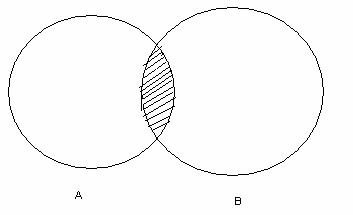 Here, the shaded region represents the intersection of two sets A and B.
So, we have
Here, the shaded region represents the intersection of two sets A and B.
So, we have

Q19. Let U = {1, 2, 3, 4, 5, 6, 7, 8, 9, 10}, A = {2, 3, 4} is a subset of B = {1, 2, 3, 4, 5}. Verify that  is a subset of
  .
.
is a subset of .Solution
U = {1, 2, 3, 4, 5, 6, 7, 8, 9, 10} and A = {2, 3, 4} which is a subset of B = {1, 2, 3, 4, 5}.
= {6, 7, 8, 9, 10} and = {1, 5, 6, 7, 8, 9, 10}
Here, we observe that is a subset of .
= {6, 7, 8, 9, 10} and = {1, 5, 6, 7, 8, 9, 10}
Here, we observe that is a subset of .
Q20. If A = {1, 2, 3, 4, 5}, B = {1, 3, 5, 8}, C = {2, 5, 7, 8}, verify that A – (B  C) = (A – B)
  (A – C).
C) = (A – B) (A – C). Solution
B C = {1, 2, 3, 5, 7, 8}
L.H.S. = A – (B C)
= {4}
Now, A – B = {2, 4}, A – C = {1, 3, 4}
R.H.S. = (A – B) (A – C)
= {2, 4} {1, 3, 4}
= {4}
C = {1, 2, 3, 5, 7, 8}
L.H.S. = A – (B C)
= {4}
Now, A – B = {2, 4}, A – C = {1, 3, 4}
R.H.S. = (A – B) (A – C)
= {2, 4} {1, 3, 4}
= {4}
Q21. Write the set {x : x is a month of a year not having 30 days} in roster form:
Solution
{January, February, March, May, July, August, October, December}
Q22. Are A = {x : x – 5 = 0} and B = {x : x is a positive integral root of the equation x2 - 2x - 15} equal sets?
Solution

Q23. 
Solution
Here, A = {2, 4, 6, 8, 10, 12, ---}
B = {3, 6, 9, 12, ---}
C = {4, 8, 12, 16, ---}
Now, A  B = {6, 12, ---}
(A B) C = {6, 12, ---} {4, 8, 12, 16, ---}
= {12, 24, ---}
i.e. (A B) C = {12x : x
B = {6, 12, ---}
(A B) C = {6, 12, ---} {4, 8, 12, 16, ---}
= {12, 24, ---}
i.e. (A B) C = {12x : x  N}
N}
B = {6, 12, ---}
(A B) C = {6, 12, ---} {4, 8, 12, 16, ---}
= {12, 24, ---}
i.e. (A B) C = {12x : x N}
Q24. In a group of 85 people, 50 like Hindi movies, 10 like both Hindi and English movies. How many like English movies and not Hindi. How many like English movies?
Solution
Let H denote the set of people who like Hindi movies and E be the set of people who like English movies, then
n(H  E) = 85, n(H) = 50, n(H
  E) = 10
We know that,
n(H E) = n(H) + n(E) – n(H E)
E) = 10
We know that,
n(H E) = n(H) + n(E) – n(H E)
 85 = 50 + n(E) – 10
n(E) = 45
No. of people who like English movies and not Hindi = n(E – H)
Also, n(E) = n(E – H) + n(E H)
n(E – H) = 45 – 10 = 35
85 = 50 + n(E) – 10
n(E) = 45
No. of people who like English movies and not Hindi = n(E – H)
Also, n(E) = n(E – H) + n(E H)
n(E – H) = 45 – 10 = 35
E) = 85, n(H) = 50, n(H E) = 10
We know that,
n(H E) = n(H) + n(E) – n(H E)
85 = 50 + n(E) – 10
n(E) = 45
No. of people who like English movies and not Hindi = n(E – H)
Also, n(E) = n(E – H) + n(E H)
n(E – H) = 45 – 10 = 35
Comments
Post a Comment